.jpeg)

You Don't Want to Do Less. You Want to Do More of What Matters.
John Lunsford, Founder and CEO of Tethral
This article is not for the version of you that needs to exhale. I wrote that one already. This one is for the version of you that is running three things on purpose.
You have the full-time job, the side project that might become the next job, and something else that doesn't fit into either category but you refuse to let go of because it is part of who you are. Maybe it is a creative practice, maybe it is a second income stream, maybe it is the thing you do between 9pm and midnight that makes the other two feel worthwhile. You are not struggling to keep up. You are keeping up, and you know you could be doing it better if the logistics of your life weren't eating the best hours of your day.
This is not burnout. This is ambition running on an infrastructure designed for a single-job, single-identity life that hasn't existed for most of your adult years.
The Coordination Tax on Ambition
Here is the thing nobody tells polyworkers, freelancers, portfolio careers, people holding multiple commitments by choice: the hardest part of doing more isn't the work itself. It is the transitions between the work.
The context switch from your day job to your side project isn't just mental. It is logistical. You close one set of tools and open another. You check whether the thing you promised your client conflicts with the meeting you moved on your primary calendar. You remember that you have a personal errand that needs to happen during business hours tomorrow and now you're negotiating with yourself about which commitment absorbs the cost. You have three schedules, two inboxes, a family calendar, and a set of domestic responsibilities that don't care how many professional identities you are managing.
None of these systems talk to each other. Your freelance calendar doesn't know about your full-time standup. Your meal planning doesn't know that Wednesday is your late night and you need something that takes ten minutes, not forty. Your smart home doesn't know which mode you're in, work-from-home for the day job or deep focus for the project that actually excites you.
You are coordinating all of this manually, and you are good at it, which is actually the problem. Because the skill you are burning on logistics is the same skill that makes you effective at the work. Every hour you spend being the integration layer between your own lives is an hour you're not spending on the thing you are trying to build.
That is the coordination tax on ambition. It doesn't show up as burnout. It shows up as the nagging sense that you could be further along if your life's infrastructure worked as hard as you do.
The Edge You're Missing Is Not a Better App
The productivity industry has spent twenty years selling you tools for this: a better task manager, a better calendar, a better note-taking system, a better time-blocking method. Each one promises to help you do more, and each one adds another system to the stack you are already manually coordinating.
The irony is brutal: every tool you adopt to manage complexity adds to the complexity you are managing. You now have a task manager that doesn't talk to your calendar, a calendar that doesn't talk to your project tracker, a project tracker that doesn't talk to your invoicing, and all of them require you to be the translation layer that moves context from one to the next.
The edge you're missing isn't another tool. It is the layer that makes the tools you already have work together without you standing in the middle.
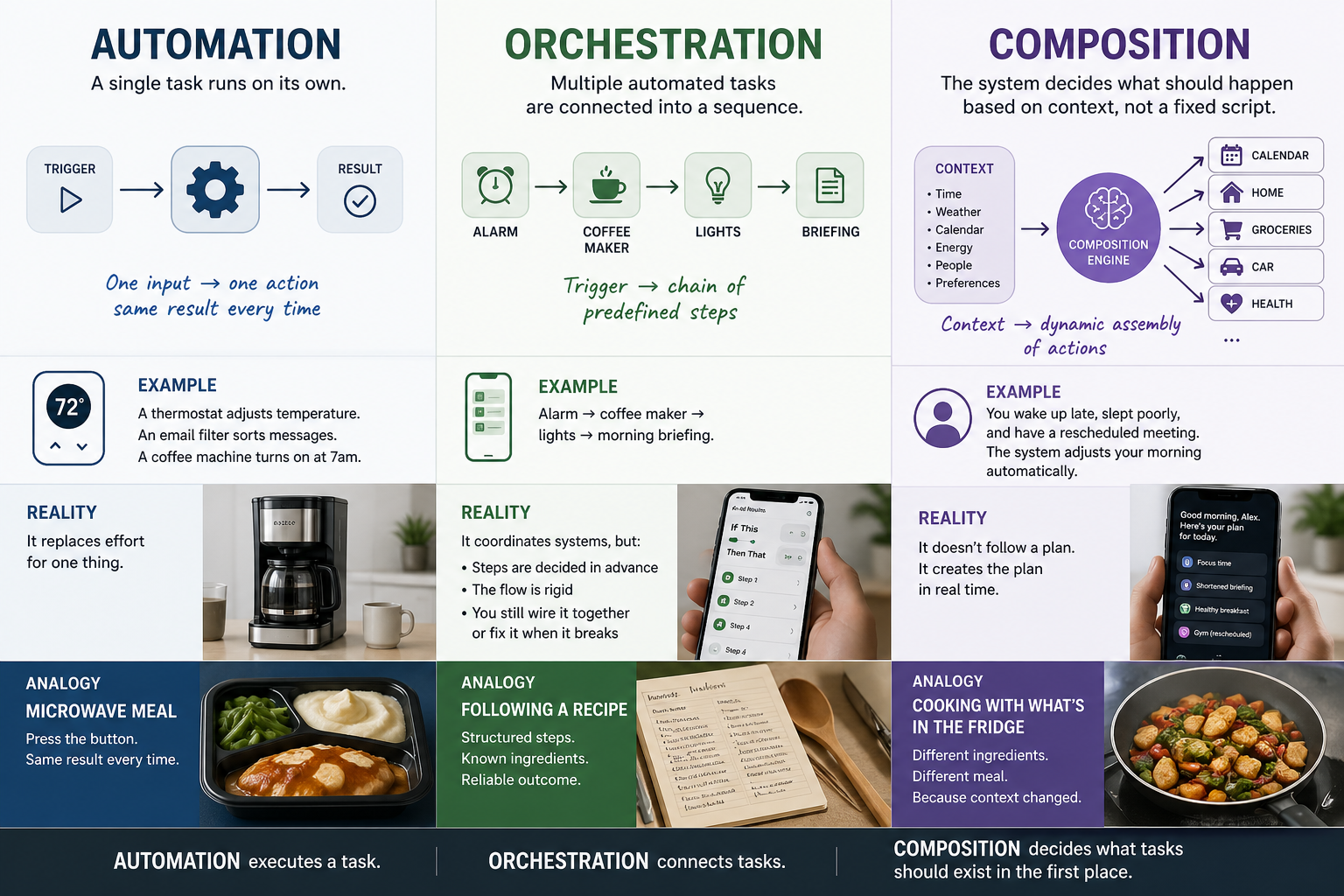
That is what a composition engine does. Not another app to manage. An infrastructure layer that sits beneath all of your apps and coordinates between them on your behalf. Your three calendars become one coordinated schedule that the system manages across contexts. Your transitions between commitments stop being manual because the system already knows what's next, what needs to shift, and what can wait. The environment around you adapts to which version of your professional life you're in right now, not because you configured a routine, but because you described how your days work and the engine learned the pattern.
What Abundance Looks Like With Infrastructure
I want to be specific about what this changes, because the difference between "slightly more organized" and "fundamentally more capable" is the difference between a tool and an infrastructure.
You wake up and the briefing knows you have your day job until 3, a client call for the side project at 3:30, and a deadline on the creative work by Friday. It doesn't just list them. It has already identified the conflict between the client call and the school pickup you forgot about, proposed a solution, and surfaced the one thing on your day job calendar that could move to create a buffer you didn't know you needed. Your morning doesn't start with twenty minutes of cross-referencing three calendars. It starts with clarity.
Your side project needs three hours of focused work this week and you haven't found them yet. The composition engine looked at your week, found that Thursday afternoon is clear across all three commitments, blocked it, silenced the notifications that would normally interrupt it, and adjusted the smart home to your deep-focus preferences. You didn't have to negotiate with yourself about when to do the work. The space was created and protected before you thought to look for it.
Your partner texts at 2pm asking if you can handle dinner tonight because their day went sideways. The system already knows what's in the kitchen, knows your schedule is tight until 6, and knows that the meal plan for tonight requires 40 minutes of prep. It suggests swapping tonight's meal with Thursday's simpler one, adjusts the grocery list accordingly, and confirms back to you in one message. You reply "yes" and the entire downstream coordination happens without you touching it.
None of these scenarios are about doing less. They are about doing everything you are already doing, but with an infrastructure that handles the coordination between commitments so your energy goes into the commitments themselves.
This Is Not About Work-Life Balance
I want to push back on a framing that the productivity world loves and that I think is wrong for this audience. Work-life balance assumes two categories in tension, where more of one means less of the other and the goal is equilibrium.
That is not how polyworkers think. You don't want equilibrium, you want throughput. You want to do the day job well, build the side project seriously, show up for your family fully, and pursue the thing that keeps you up at night without any of them degrading the others. The constraint isn't willingness or ability. It is the coordination overhead between all of them, the tax that eats capacity without producing output.
What if the infrastructure existed to eliminate that tax? Not to help you "balance" your commitments, but to let you run all of them at the level each one deserves, because the coordination between them was handled by something other than your own mental energy?
That is the abundance argument for agentic composition. Not "let the AI do it so you can rest." But "let the coordination engine handle the logistics so you can operate at the level you know you're capable of across everything you've committed to."
The person who is already doing three things and doing them well is not looking for permission to do less. They are looking for the infrastructure that lets them do all three at the level each one deserves. That is a different product than a wellness app. That is a different product than a task manager. That is a coordination engine built for people who decided that one career, one identity, one mode of contributing to the world is not enough, and who are right about that.
Why This Doesn't Exist Yet, and What We're Building
The same gap that prevents a single-job person from getting the 5:15 exhale is the gap that prevents a polyworker from operating at full capacity across multiple commitments. The systems don't talk to each other, the ecosystems are siloed, and nobody has built the coordination layer between them because every platform benefits from keeping you inside their walls.
Tethral is building that layer. An open coordination platform that sits between all of your systems, regardless of brand or ecosystem, and composes your life across them. Not a new app to learn. An engine underneath the apps you already use that makes them work together for the first time.
The companion article, "The 5:15 Message," describes what the composition engine does when you need breathing room. This article describes what it does when you want running room. Same engine, different day.
You don't want to do less. You want to do more of what matters. The infrastructure to support that is what we're building.
This is part of an ongoing series on the foundational design principles behind Lifestyle AI. For what composition is and why it matters, read "What Is Agentic Composition and Why Should You Care?" For what the same engine does when you need breathing room, read the companion article, "The 5:15 Message."
RELATED POSTS







.jpg)