.jpeg)
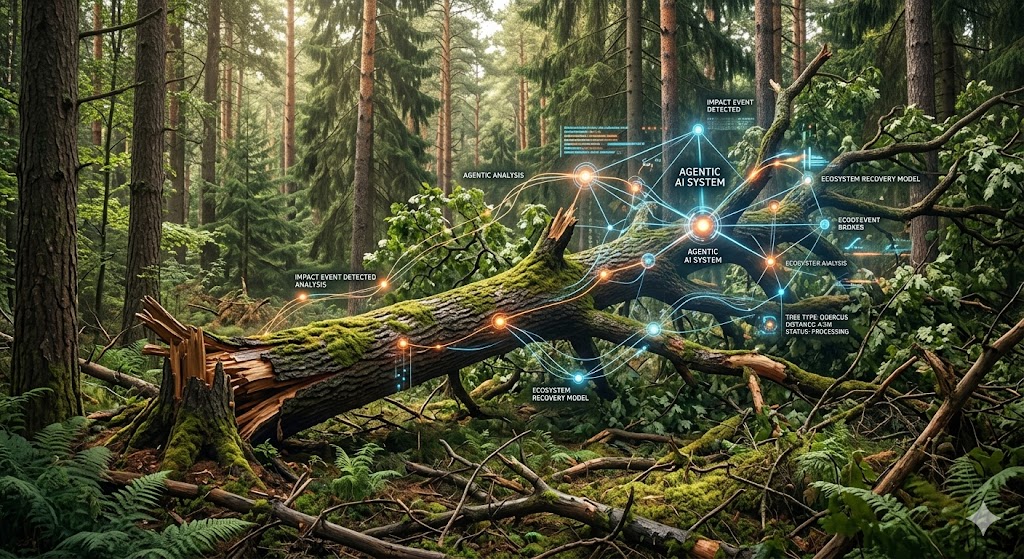
What Agent Builders Can Learn From One of Philosophy's Most Irritating Questions
There is a question that I suspect has irritated every person who has ever heard it, and if it has not irritated you yet, give it time.
If a tree falls in the forest and no one is around to hear it, does it make a sound?
I have spent a lot of time in user experience. I have spent years bringing global products to popular consumption. And one of the things that makes the most sense to me today about how AI agents should work is connected to the answer to that tree question. I have an engineering background. I also happen to have a PhD in communication and a master's in cultural anthropology. So that is where I am coming from, and it matters for what follows.
Why the Question Is Irritating
People have a hard time conceptualizing the mind of someone else. We make assumptions and we frame those assumptions in our own experience of the world. That is where the tree problem lives, and it is why the question annoys people. It annoyed me for years.
I used to think it was a question about existence and arrogance. If someone claims the tree did not make a sound, they are saying, at least implicitly, that the world does not move without their presence. That used to frustrate me because it seemed absurd on its face. Billions of people go on living their lives and we see very few of them. Of course things exist without us there to witness them. On a practical level, claiming otherwise is silly.
If you have raised kids, you have also been through the stage called object permanence. My dog has it too, or rather she has an issue with it. If you disappear from sight, you disappear from the world. Kids do not learn object permanence until later in development. My dog, apparently, never learns it.
But I digress. Let us get back to trees and AI agents.
What the Question Is Actually About
One of the wonderful gifts of complicated simple questions is that the depth of them can change as we change. What I have come to realize is that the tree question is not about arrogance as much as it is about understanding. About how humans process the world.
Humans like to see the process. We like to see the work. We like to know what happened, because that grounds us in reality. It grounds us in our physical existence, the way we experience the world through our senses and interpret the meaning of those experiences through our culture and our alignment with its values. To not see something is a disorienting experience because we then have to puzzle through what could have happened. And as we do that, some predictable problems emerge around our own misconceptions, our own assumptions, our own superstitions.
Not seeing the tree fall does not change whether it happened. But it changes everything about how we relate to the fact that it happened. We lose the sensory grounding. We lose the narrative. We lose our place in the event. And when you lose all three of those, what you are left with is not disbelief. It is discomfort.
What This Has to Do With AI Agents
It has to do with their presence and their absence.
I just saw yet another founder make another big bet on a future of AI that removes the human entirely from decision making as a proxy for making things easier. But the glaring gap is his core assumption is that decisions are the same as participation. The agent does everything. The person receives the outcome. No process. No participation. No tree falling. Just the sound arriving out of nowhere. It might happen fast, but was it satisfying?
And yet this is not the first time this mistake is made at-scale, if you follow the downfall of the Humane Pin, what they failed to get right is exactly that balance between the doing of the work and the participation in the experience. They built a product that acted on your behalf but gave you no role in the action, no window into the process, and no way to feel your own presence in what the technology was doing for you. People did not reject the capability. They rejected the absence of themselves reflected back in a sterile experience.
A few years back, when I was leading the research for Uber Teens, one of the balances we had to consider was that the filling of a need was not just transportation. You also needed to fill the performance of care that parents and guardians communicated by taking time to transport their loved ones. The ride itself was table stakes. The emotional signal that mattered was a parent saying, through their presence in the process, that this child is important to me and I am involved in getting them where they need to go. It was not enough to pay someone else to do it and have it happen behind the scenes. For most people, the process of care is essential. without it, you're just paying someones ride home.
That insight maps directly onto the tree problem. It is not about whether the tree made a sound. It is about how it made you feel when it fell and you were not there.
The Agent Design Problem Nobody Is Talking About
The AI agent industry is building toward a future where agents do more and more on your behalf with less and less involvement from you. That is the technical trajectory, and the engineering is exciting. But the design question underneath it is one that most builders have not seriously engaged with.
When an agent acts on your behalf, it still needs to address the experience it is trying to produce. Not just your functional needs. Your need to understand what happened. Your need to feel that your values were reflected in how it happened. Your need to see yourself, even faintly, in the process. Without that, you do not get adoption. You get the Humane Pin.
This is not about AI guardrails. It is about knowing the kind of experience you are designing and, just as importantly, what you are designing out of the experience.
I think back to the early GPT days, when the conversation around AI enablement kept circling back to getting AI to do the dishes. Automate the chore. Remove the friction. Eliminate the task. But it is not about the dishes, just like it is not really about the tree. I know several people who feel that washing the dishes after a meal has a meditative quality, that the activity of cleaning and organizing provides something significant for them emotionally and psychologically. The task is not just a task. It is an experience that serves a purpose beyond its function.
I am not saying no robots doing the dishes. But I am saying that experience is the gate to adoption, and without it, products fail.
There is a difference between an agent that removes you from a process and an agent that represents you in a process. The first one is a tree falling in a forest you never visit. The second one is a tree that falls exactly the way you would have wanted it to, and you know it, because the agent made sure you could feel your role in the outcome even if you were not there swinging the ax.
The builders who understand this distinction will be the ones whose products have staying power. Not because the agent is capable. Because the agent makes the person feel capable, present, and valued in a world that is increasingly being coordinated on their behalf.
That is the real answer to the tree question. The sound matters because it fosters experience, a way of knowing about and relating to the world. And any agent-building company that forgets that will learn it the hard way. Again.
This is part of an ongoing series on the foundational design principles behind Lifestyle AI.
RELATED POSTS





.jpg)