.jpeg)
What Is Agentic Composition and Why Should You Care?
John Lunsford, Founder and CEO of Tethral
I started building Tethral because I felt like the middleware for the tech in my own life.
I have a background in platform security engineering, AI safety research, and a PhD focused on how people adopt and integrate technology. I should be the person who can wire their connected life together. And I could, technically. It was just punishingly complex, even for me. The promise of connected technology, a seamless ecosystem where your devices and services coordinate around your needs, turned out to require a full-time human integration layer to function. That human was me, and if it was this hard for someone with my background, the promise was broken for almost everyone.
It started, like a lot of things in California, with fire season. Almost two years ago, during one of the stretches where a wall of smoke could roll down from the hills at any moment, I wanted something simple. At a smoke alert, close the windows, turn on the air purifier, text my partner to get the kids and the dog inside, and don't turn on the AC. Five actions across four systems. The kind of coordination that the connected technology industry had been promising for almost twenty years.
It didn't work. Not because the individual devices couldn't do their part, but because nothing connected them. The weather app didn't talk to the smart home. The smart home didn't talk to the messaging service. The air purifier didn't know about the windows. Each device was capable on its own and useless in concert, because the layer that would coordinate between them simply did not exist.
That was the moment connectivity stopped being a hobby for me and started being a problem worth solving.
The Words the Industry Uses and What They Miss
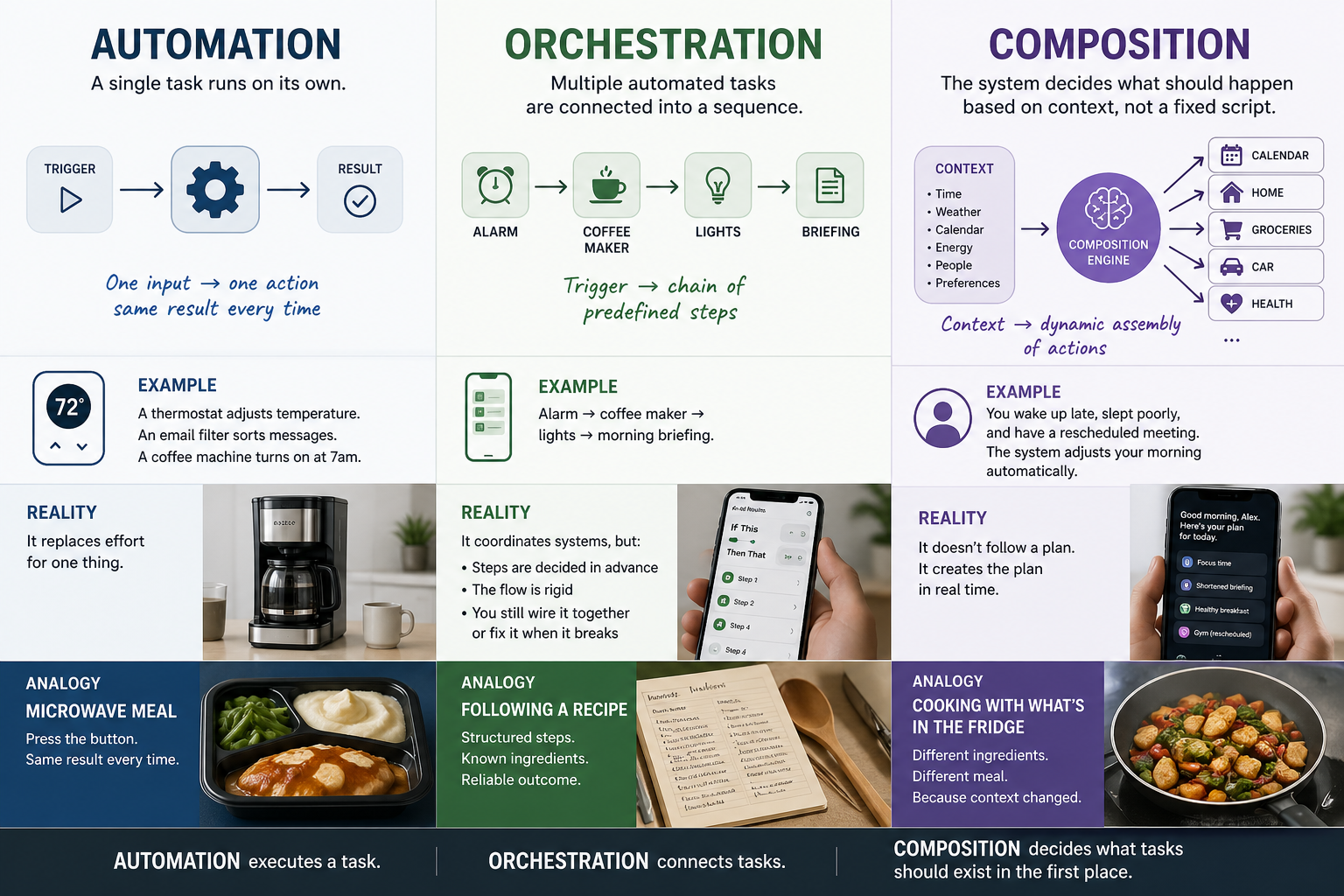
Automation is everywhere, and it should be. A dishwasher automates the washing of dishes, a thermostat automates temperature, an email filter automates sorting. Automation trades the space of a worker, replacing the labor of a single task with something that runs on its own. That is valuable, and nobody is arguing we need less of it.
Orchestration is a step above. It is the weaving together of separate automated tasks into a sequence. Your morning alarm triggers the coffee maker, the coffee maker's completion triggers the lights, the lights cue the briefing. Each piece is automated, but someone or something had to connect them, decide the order, and make them run together. Right now that someone is usually you, manually linking apps and devices into chains, or it is a company's boilerplate, an inflexible, one-size-fits-all preset that works for a demo and breaks the moment your life deviates from the script. Either way, the weaving is rigid. Change one input and the whole sequence needs to be rebuilt.
We used the word orchestration for almost two years. But working in the space changed how I think about it, because orchestration assumes the steps are known in advance and the context is stable, and if connected technology is ever going to break out of the shell it has been stuck in for the last twenty years, that assumption has to go.
I say connected technology deliberately, not IoT. That switch matters. IoT expectations have been narrowed so steadily over the years that most people can't think outside the if-lock-then-lights statements the industry trained them to accept. I was talking with an investor recently who said "well, I really only have these Govee lights," meanwhile not thinking about his car, earbuds, phone, printer, television, front door camera, or the battery of services he subscribes to. That is where the term IoT does a disservice, not just to the mesh of connected things each of us actually lives inside, but to our ability to imagine what that mesh could do if it were coordinated. We have been treating the roof as the sky. What we thought bounded connected technology doesn't actually have to.
And that is partly why orchestration has been the ceiling of ambition for so long. Orchestration is just a shift of where you, the middleware, have to put in the work, while still having to tolerate its rough, unadaptive edges. It connects known things in known ways. It doesn't adapt to the context of your life as it changes, which in practice means it breaks the moment your Tuesday stops looking like your Monday.
What Composition Actually Means
Lovable lets you describe an app and it builds it. You don't write code, you describe what you want in plain English, and a working product comes back. That changed software because it removed the gap between having an idea and having the thing.
Agentic composition does the same thing for how you live.
You describe what you want your life to feel like, and a composition engine translates that into coordinated action across the systems you already use: your calendar, your home, your groceries, your car, your health data, your partner's schedule, your kids' commitments. The engine reads the context of your life right now, this morning, this week, this situation, and assembles a response from whatever systems are available. Not a fixed sequence. A contextual composition shaped by who you are and what the moment requires.
Think of it this way. Automation is a microwave meal: press the button, same result every time, and it solves a real problem. Orchestration is following a recipe: structured steps, known ingredients, reliable outcome, but you still need to be there managing the process. Composition is cooking with what's in the fridge for whoever is actually coming to dinner tonight. Same kitchen, different meal every time, because the context changed. The ingredients, the guests, the time you have, what you're in the mood for, all of that shapes what gets made. That is the difference between a system that runs a fixed sequence and a system that reads the situation and responds.
Your life is not a recipe. The system shouldn't behave like one.
Why the Flexibility Matters More Than You Think
If automation is one-size-fits-all, composition is made to fit. Both cover you, but one was designed for everyone in general and the other was designed for you in particular. Hard-coded automations have their place, the way any standardized solution does, when the context is predictable and the variation doesn't matter. But the moment you need the system to respond to how you actually live, to your sleep, your stress, your schedule, your shifting priorities across a week that never looks exactly like the last one, the one-size stops fitting.
And this is where something important needs to be said about what that fit means. Anything that touches your skin, that reads your biology, that knows how you slept and what your week looks like and when your kids need to be picked up, that system is not just functional. It is intimate. The flexibility of composition isn't just a better product feature. It is a safety requirement. A rigid system acting on personal data is a system that will eventually do the wrong thing in the wrong context and not know the difference. A contextual system that adapts to who you are and where you are has a fundamentally different relationship to the person it serves, one where the response is shaped by the moment, not stamped from a template.
That is what I mean when I say composition should feel personal, because it is personal. The data it works with, the routines it shapes, the environment it produces around you, those are the textures of your actual life. The system that handles them should not just be smart. It should feel safe.
What This Looks Like in Practice
Let me make it concrete with three scenarios that show the range, from the everyday to the unexpected.
Your agent checked your sleep data before you woke up. You slept badly. The lights came up slower than usual, your briefing was shorter, just the three things that actually need your attention today, and everything else held until you're ready. You didn't ask for that. You described, once, what a good morning feels like when you're running on empty. The engine composed it from whatever data was available that day.
It's Sunday night and you've been avoiding the question all weekend: what are we eating this week? The agent already checked your kitchen, your calendar, and your delivery options. Three simple meals for the nights you're home, nothing for Thursday because you have a dinner out, and a grocery delivery window that fits tomorrow morning. You didn't open a meal planning app. The composition engine already knew the shape of your week and built around it.
Your house gets a water leak alert while you're at work. The agent checked plumber availability, booked the one with better reviews for a time that fits your calendar, configured temporary access on your smart lock, and activated monitoring. You got a text that said: handled, here are the details, let me know if you want to change anything. Seven systems across four ecosystems, coordinated in the time it took to read the message.
Each of these is the same engine doing the same thing: reading the context of your life, assembling a response from available systems, and delivering it as a coordinated experience rather than a list of tasks for you to manage.
Why This Doesn't Exist Yet
Not because the AI isn't ready. The models exist, the language understanding is here, and the ability to reason across context and preferences is real.
What's missing is the coordination layer between systems. Your grocery service doesn't talk to your calendar, your calendar doesn't talk to your smart home, and your smart home doesn't talk to your health data. No single company connects all of these because no single company has an incentive to. Each one benefits from keeping you inside their app, their ecosystem, their subscription. You stay the middleware because the middleware is where their revenue model needs you to be.
Connecting tech across these boundaries is hard. I know that because I've been building it. Different protocols, different capabilities, different ecosystems, all competing for your attention and your lock-in. Twenty years ago, hubs provided order to the chaos of early connected technology, and there was genuine value in that. But the hub model also baked in the assumption that connection means buying into a single vendor's vertical, and that assumption is what keeps the coordination layer from existing.
That is the gap Tethral exists to close. An open coordination platform that sits between systems, belongs to none of them, and serves the person. The composition engine translates natural language into coordinated action across any system, any brand, any ecosystem. Not another app to manage. The layer underneath your apps that makes them work together for the first time.
We are building this because composition changes what connected technology can be. It stops being a collection of devices you manage and starts being an infrastructure that manages itself around you. Two companion articles explore what that means in practice: one for the person who wants to stop being the glue that holds their life together, and one for the person who is already holding it together and wants the leverage to do even more.
This is part of an ongoing series on the foundational design principles behind Lifestyle AI.
RELATED POSTS







.jpg)