.jpeg)
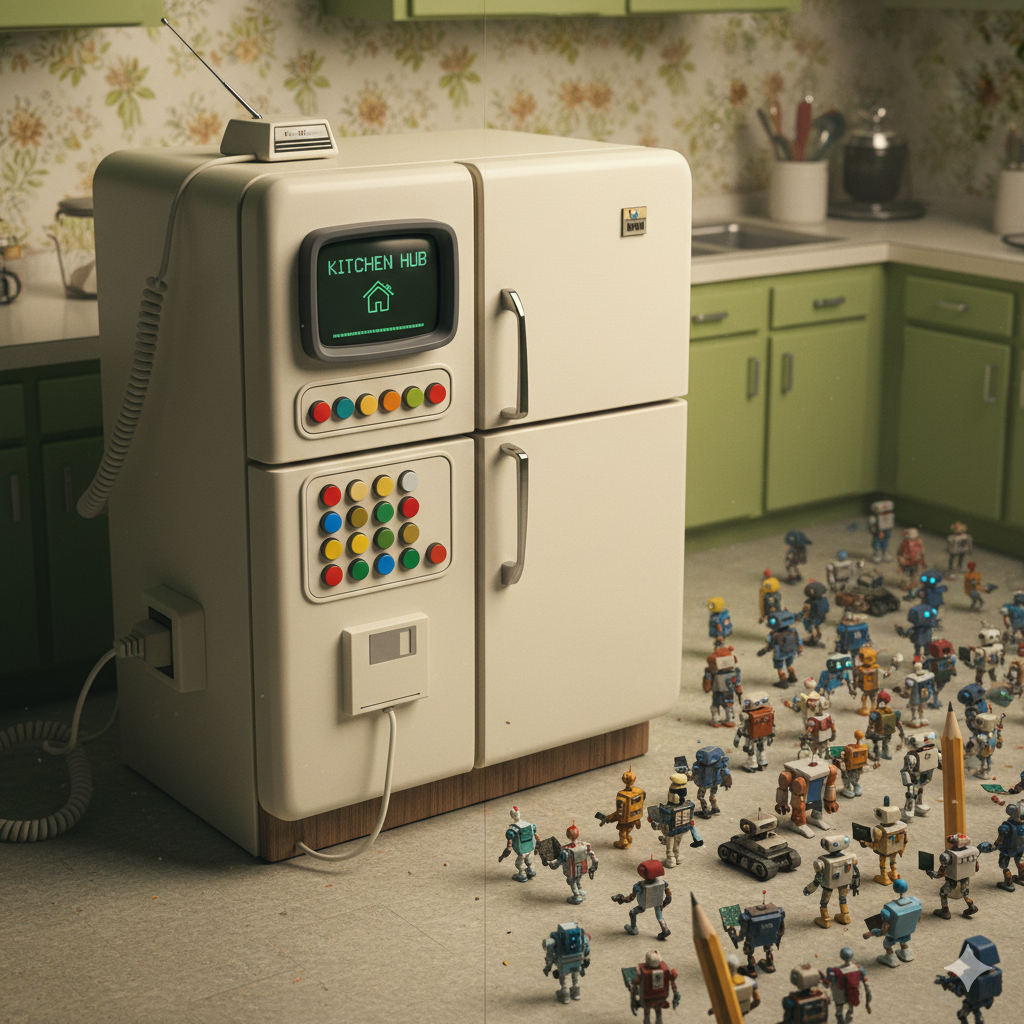
The Internet of Things Did Not Start With Smart Fridges. It Started With a Problem Nobody Has Solved Yet.
The Internet of Things did not start with smart fridges. That is worth saying up front, because most people encounter IoT only after it has been shrink-wrapped, app-ified, and marketed as convenience. Lights that turn on by voice. Thermostats that learn. Doorbells that watch the street. By the time IoT reaches consumers, it already looks finished. Even inevitable.
In reality, IoT began as a very scrappy idea, built by engineers who were mostly trying to solve boring problems. And the boring problem they were solving turns out to be the most important unsolved problem in computing today. They just did not know it yet.
Where it started
The earliest versions of IoT were not about intelligence. They were about visibility.
In the late 1980s and early 1990s, networks were growing faster than humans could monitor them. Servers were becoming distributed. Machines were increasingly left alone in rooms, closets, basements, factories, and data centers. Engineers needed to know simple things. Is the machine on. Is it overheating. Is it responding. Is it still there.
The first "things" on the internet were not consumer devices. They were vending machines, printers, HVAC systems, industrial controllers, and sensors bolted to equipment that already existed. One famous early example was a networked Coke machine at Carnegie Mellon that reported whether it was stocked and cold. This was not innovation theater. It was convenience for people who did not want to walk across campus just to find an empty machine.
That pattern repeated everywhere. Attach a sensor. Expose a status. Reduce wasted trips. Reduce guesswork. Reduce downtime.
IoT was born as instrumentation. And instrumentation, for a while, was enough.
The shift nobody named
As sensors got cheaper and networks got better, the number of connected things exploded. Suddenly it was not one vending machine or one industrial controller. It was hundreds, then thousands, then millions of devices reporting state.
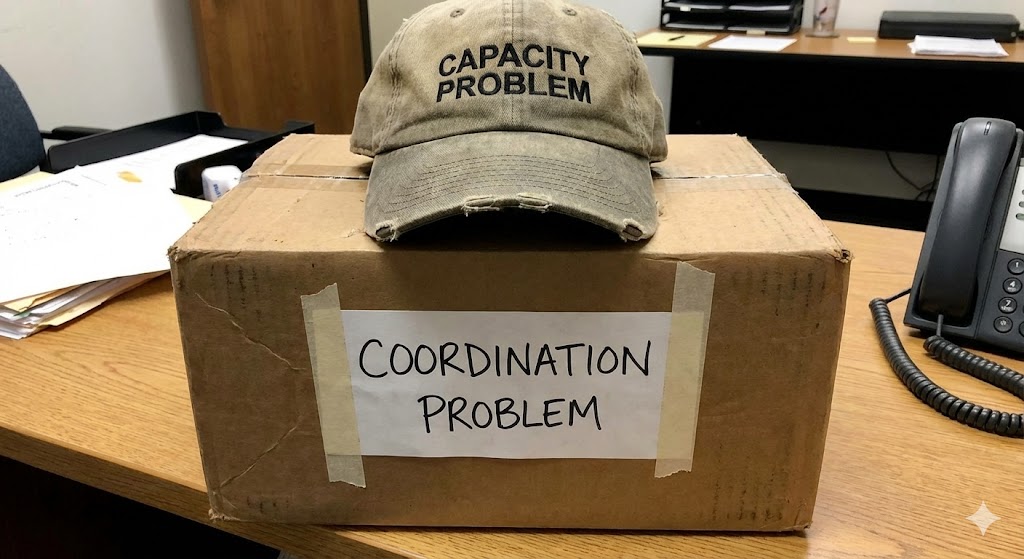
This is where the story gets interesting, and where it stops being a technology story and becomes a coordination story.
Once you have many devices reporting state, you stop asking "is it on" and start asking "how are they behaving together." Temperature sensors across a building reveal airflow problems that no single sensor can see. Power meters across a grid reveal load patterns invisible to any individual meter. Motion sensors across a warehouse reveal inefficiencies in layout that only emerge at the system level.
IoT quietly shifted from monitoring individual things to observing systems. And observing systems required something fundamentally different from observing things. It required understanding interactions.
This was the moment when coordination became more important than intelligence. You did not need each device to be smart. You needed the system to behave well. Factories were early adopters of this mindset. So were utilities, logistics companies, and telecom providers. They cared less about dashboards and more about preventing cascades. One overheating machine should not bring down a production line. One delayed shipment should not ripple across a supply chain. One noisy sensor should not trigger a false alarm storm that desensitizes the operators who need to respond to the real one.
IoT, in practice, became about managing interactions. But nobody built the infrastructure to do that well, because the industry was still telling itself a story about intelligence, and the coordination problem did not fit the narrative.
The consumer turn
The consumer IoT wave arrived much later, and it changed the narrative in ways that were both commercially successful and architecturally misleading.
When smartphones became ubiquitous, suddenly every household had a control surface. When Wi-Fi chips became cheap enough to embed in a lightbulb, suddenly every appliance could be connected. Companies realized they could sell not just products but ongoing relationships. Smart homes emerged. Voice assistants followed. The promise shifted from visibility and coordination to convenience and personalization.
This was not a bad thing. But it distorted expectations in a way that the industry is still recovering from.
Consumers were shown polished demos where devices cooperated seamlessly. Under the hood, the reality was far messier. Each device came with its own app, its own cloud service, its own update cycle, and its own failure mode. Coordination was mostly manual, frequently fragile, or bolted on after the fact through rules engines that broke the moment a device updated its firmware or a cloud endpoint changed its behavior.
What had worked in factories and infrastructure, where coordination was explicit, where protocols enforced it, where engineers designed for it from the start, did not translate cleanly into homes. Homes are chaotic. People move unpredictably. Devices are added and removed constantly. Networks are unreliable. Privacy matters in ways that industrial environments never had to consider.
IoT became widespread before it became coherent. That gap has never closed.
Why IoT feels stuck
Today, IoT is everywhere and nowhere at the same time.
Most people own multiple connected devices. Few feel like those devices truly work together. Integrations break. Automations feel brittle. When something goes wrong, it is often unclear which device is responsible, or whether the problem is even attributable to a single device at all.
From the outside, this looks like a software problem. Better apps. Better AI. Better voice recognition.
From the inside, it is a coordination problem. And it always has been.
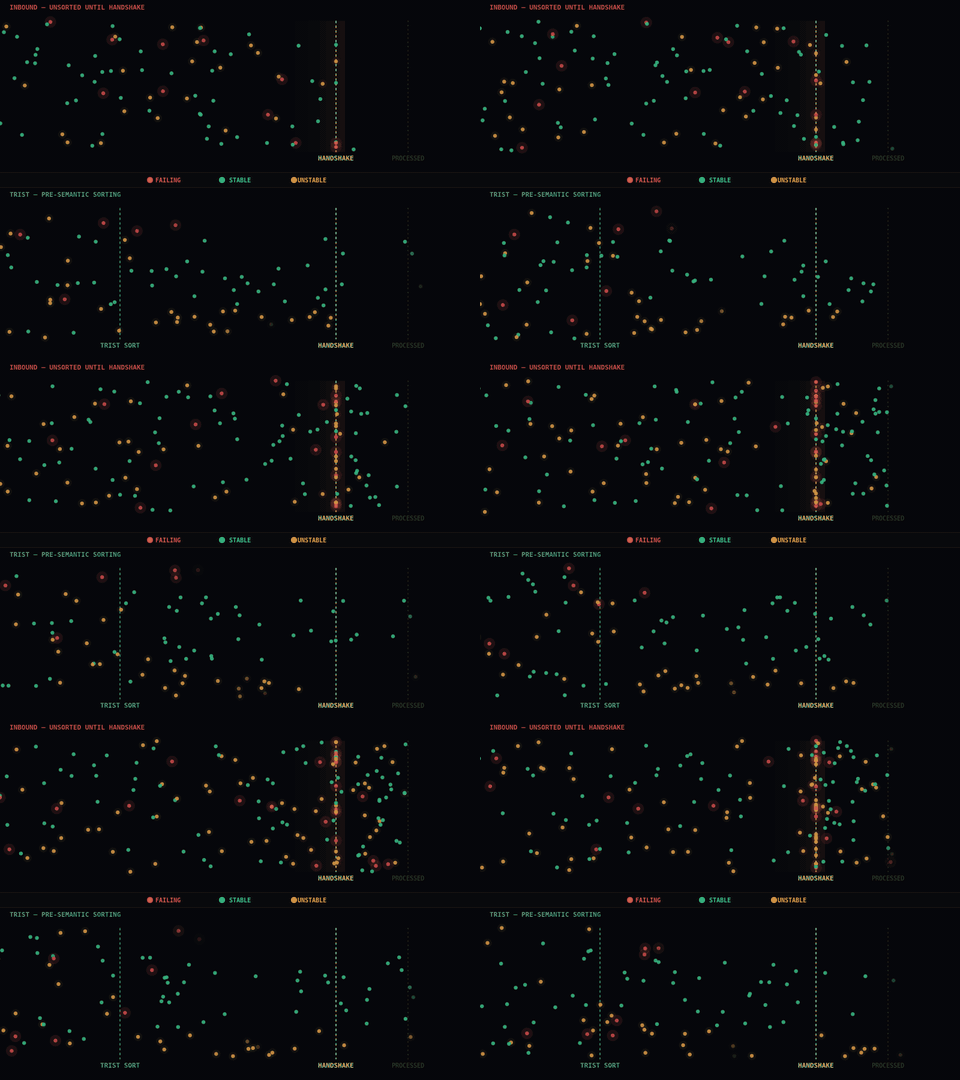
IoT systems struggle not because devices are unintelligent, but because interactions are unmanaged. One device retries aggressively when a dependency slows down. Another times out silently. A third assumes success and moves on. Small mismatches compound. The system technically works, in the sense that no individual component has failed, but the experience degrades in ways that nobody can explain because nobody is watching the interactions between the components. They are watching the components.
This is not unique to homes. The same patterns appear in industrial IoT, in healthcare devices, in smart city infrastructure. The scale is different. The failure modes rhyme.
IoT grew faster than our ability to reason about collective behavior. And then we built something much bigger on top of the same unresolved problem.
The lucky accident of timing
Here is where the story stops being about IoT and starts being about everything.
Fast forward to today. The problems IoT has been trying to solve, poorly, for three decades have finally gone mainstream. Not because smart fridges achieved mass adoption. Because agents did.
AI agents now carry our agency. They perform tasks on our behalf, conduct interactions, exercise purchasing power, wield authority. They negotiate with services. They orchestrate workflows. They make decisions in environments they were not designed for, on timelines they cannot fully control, with dependencies they cannot fully see.
And they are experiencing, at scale, the exact coordination problem that IoT has been stumbling over since the Coke machine at Carnegie Mellon.
The retry storms that plagued industrial IoT are now plaguing multi-agent workflows. The cascade failures that took down factory lines are now taking down inference pipelines. The brittle automation that frustrated smart home users is now frustrating enterprise customers whose agents cannot gracefully handle a degraded dependency. The coordination gap that nobody closed in IoT is now the coordination gap in agentic AI, only the cost per failure is orders of magnitude higher because the agents are spending real money on every interaction.
This is not an analogy. It is the same problem, operating at a different scale, with higher stakes, in a world that is finally paying attention to it.
It is a lucky moment to have been working in multi-agent orchestration before that is what it was called. Because the coordination problem is about to be everywhere, and in places you never thought to look: in your CI/CD pipeline, in your customer service stack, in your financial operations, in any system where multiple autonomous actors interact without a shared understanding of each other's assumptions. The IoT people saw this coming. They just could not convince anyone it mattered until the agents started burning money.
The future of IoT and the future of agentic AI are the same future. They always were. It just took thirty years and a few hundred billion dollars in AI investment for the rest of the industry to arrive at the same coordination problem that a networked Coke machine surfaced in 1982.
John Lunsford is the CEO and founder of Tethral, and the inventor of TriST, a geometric coordination protocol for agentic AI systems. Before it was called multi-agent orchestration, it was called IoT. He has been working on this problem for longer than the current terminology has existed.
RELATED POSTS




.jpg)