.jpeg)

The 5:15 Message: What It Feels Like When Your Life Finally Has a Chief of Staff
John Lunsford, Founder and CEO of Tethral
The inability to stop working is one of the defining anxieties of modern life. Plenty of people love their work, find deep meaning in it, or have the kind of job where the boundary between on and off was never really there to begin with. The issue isn't that work is bad. It is that the transition from working to not working and back again has no infrastructure.
You don't know if you're done, or if something is going to pull you back in, or if the thing you forgot to do is going to surface at 9pm as a notification that ruins the evening you were trying to have. So you stay and check one more thing. You keep the laptop open on the counter while you make dinner, not because you're working but because you don't have permission to stop. Nobody told you the day was over, and you don't trust that it is.
Now imagine your phone buzzes at 5:15 and it says:
"You have been in back-to-back meetings since 1pm. Nothing urgent is left for today. I pushed your evening reminder for the mortgage document to tomorrow morning. Dinner reservation is confirmed for 7. Traffic is normal, leave by 6:30."
That is not a productivity hack. That is an exhale. The system is telling you, with the authority of having actually checked, that you can leave. Not because a wellness app thinks you've been working too long, but because there is nothing left that needs you today and the things you were carrying in the back of your mind have been handled.
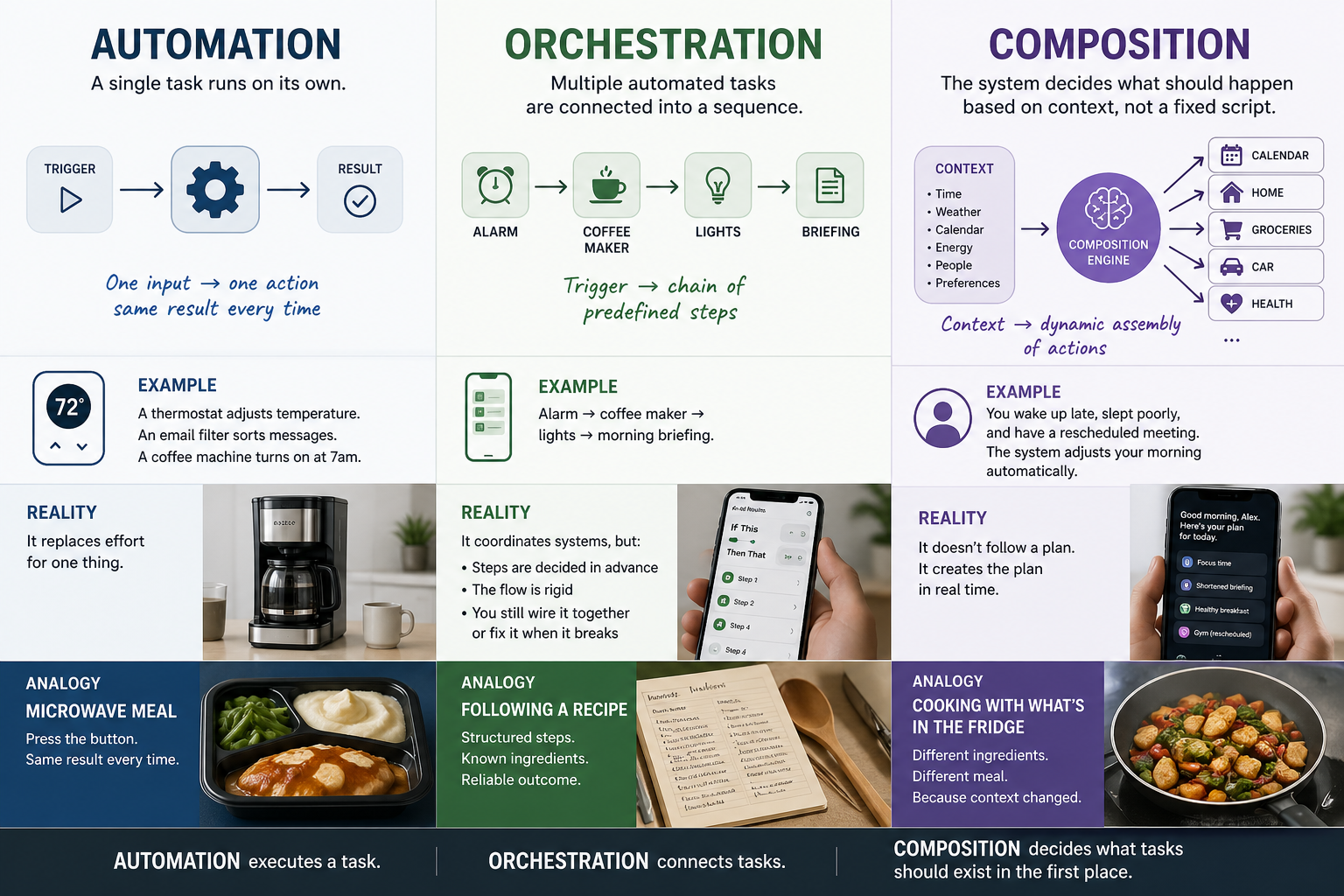
This is what agentic composition feels like in practice. I wrote separately about what composition is, how it differs from automation and orchestration, and why it requires a coordination layer the industry hasn't built. This article is about what it feels like when that layer exists. And the reason I keep coming back to it isn't the technology. It is the fact that this feeling, the feeling of being able to actually stop, is something most people haven't experienced since before they had a smartphone.
But You Can't Fix the End of the Day at the End of the Day
Here is what I learned building this: the 5:15 message doesn't work if you wait until 5:15 to compose it. The reason you can't stop working isn't that 5pm is chaotic. It is that the entire day was never organized in a way that gave you a clear signal of when you were done.
The fix starts in the morning.
"Good morning. You slept 5 hours and your recovery score is low. I shortened your briefing to just three things: the investor call at 11 moved to 11:30, your dry cleaning is ready for pickup, and school pickup is at 3:15 today not 3:30. Everything else can wait. Your coffee order went through and should be ready by the time you are dressed."
That message is a chief of staff. Not the kind that costs $150,000 a year and sits outside a corner office, but the kind that knows how you slept, knows what's on your calendar, knows the difference between what actually needs your attention today and what is just noise, and makes the first decision of your day for you: here is what matters. Everything else, I have it.
The morning briefing is what makes the 5:15 exhale possible, because the system wasn't just passively waiting for the day to end. It was actively managing the shape of your day from the moment you woke up, tracking what was essential, what could move, and what you were going to forget. It handled the gap between what you needed to do and what you would have spent mental energy worrying about.
A chief of staff that only works at the end of the day is a summary. A chief of staff that works from the beginning of the day is a different experience of being alive.
The Sunday Night Version
If the daily version is the morning briefing that makes the evening exhale possible, the weekly version is what happens on Sunday night.
You know the feeling. It's Sunday evening and somewhere in the back of your mind is a question you've been avoiding all weekend: what are we eating this week? It's not a hard question so much as an exhausting one, because it's not actually one question. It's what do we have, what do we need, what nights are we home, what nights are we out, who is picking up the kids on which days, does anyone have a thing on Wednesday, and can I get a delivery window that doesn't conflict with the morning.
Meal planning is not difficult, except when it is. Except when you are tired, hungry, worried, stressed, busy, deep in thought, having fun, or just about any other condition that can occur on a Sunday night. It is one of the most consistent coordination failures in adult life, combining inventory, scheduling, logistics, and decision fatigue into a single recurring task that nobody enjoys and everybody does. The mental load research on this is substantial, it is disproportionately carried by one partner, and it happens every single week whether you are ready for it or not.
"Hey John, you have nothing planned for dinner Monday through Wednesday, and you have a dinner out Thursday. I checked your kitchen and you're low on staples. I put together three simple meals that match your week and a grocery list to go with them. There's a delivery window tomorrow between 10 and noon that fits your schedule. Want me to place it or do you want to review it first?"
That is not a meal planning app. A meal planning app asks you what you want to eat. This is a system that already understood your week, your inventory, your constraints, and your preferences, and acted on them. It didn't ask you to coordinate. It removed coordination as a task.
The Exhale at Every Scale
The 5:15 message is the daily exhale. The Sunday grocery composition is the weekly one. But the pattern extends to every scale where coordination labor currently falls on you.
Your 2 o'clock ran long. Without you noticing, the agent moved your dry cleaning pickup to tomorrow, texted your partner that dinner will be 30 minutes late, and nudged the restaurant reservation from 7 to 7:30. Four systems, one intent, no interruption. You walked out of the meeting and your evening was already rearranged.
Your house gets a water leak alert while you're at work. The agent booked a plumber, configured temporary access on your smart lock, activated monitoring, and sent you a summary. Seven systems across four ecosystems, composed into a single message that ended with: let me know if you want to change anything.
Each of these is the same thing: the system handling coordination so you don't have to. Not the decisions, which remain yours, but the labor of stitching together systems that should have been able to coordinate on their own. Right now, you are the integration layer, the middleware holding it all together with mental energy, five apps open at once, and the quiet suspicion that you forgot something. Composition removes you from that role.
What This Gives Back
Up to this point, I have been talking about what composition takes off your plate: the coordination labor, the mental load, the Sunday night dread, the 9pm notification anxiety. That matters, and for most people it is reason enough.
But composition doesn't just free you from being the glue that holds everything together. It gives you something back.
Your chief of staff doesn't have to live inside the 9-to-5. It becomes your house manager, your personal assistant, that extra layer of preparation that means you walk into every room, every meeting, every evening already a step ahead. The morning briefing doesn't just tell you what's happening, it shapes the day so that the version of you that shows up is the one you actually want to be. The grocery composition doesn't just remove a chore, it gives you back Sunday evening, and whatever you wanted that time for, you get it.
The future of this technology is not a smarter chatbot. It is a system that composes your life around you so you're no longer the one that has to hold everything together, and instead you become the one who gets to decide what to do with the time and attention you just got back.
So you can get the 5:15 message that says nothing urgent is left, and actually believe it, because a system you trust checked.
This is part of an ongoing series on the foundational design principles behind Lifestyle AI. For what composition is and why it matters, read "What Is Agentic Composition and Why Should You Care?" For what the same engine does when you want running room instead of breathing room, read the companion article on agentic composition and abundance.
RELATED POSTS








.jpg)